Microcontroller (engl. Microcontroller Unit, often abbreviated as MCU) is an integrated circuit that combines a complete small computer on a single chip. A microcontroller typically contains a CPU, RAM, ROM or Flash memory, as well as numerous peripheral functions such as timers, GPIO ports, communication interfaces, or analog-to-digital converters.
The main difference compared to a classical microprocessor is that with a controller, the most important system components are already integrated directly into the chip. While a microprocessor usually requires external memory and additional peripherals, an MCU can perform many tasks autonomously. This results in very compact and cost-effective electronic systems.
MCUs are today the central processing unit of many Embedded Systems. They perform control, regulation, monitoring, or signal processing tasks in technical devices.
Content
Historical Development of the Microcontroller
The development of embedded MCUs is closely linked to the history of microprocessors. The first commercial microprocessors emerged in the early 1970s. These building blocks exclusively contained the Central Processing Unit (CPU). For a functional system, several external chips were also required, including program memory (ROM), working memory (RAM), and I/O chips.
A typical system of this era therefore consisted of several integrated circuits on a printed circuit board. This architecture was comparatively expensive, required a lot of space, and caused higher energy consumption.
The first commercially successful MCU was the Texas Instruments TMS1000, which was introduced in 1974 by Texas Instruments and was based on the TMS1802NC from Gary Boone and Michael Cochran. This chip is considered the first general-purpose controller because it integrated all essential components of a computer system onto a single semiconductor chip.
The TMS1000 was the first to combine the four central building blocks of a classic computer architecture: CPU, RAM, ROM, and I/O pins.
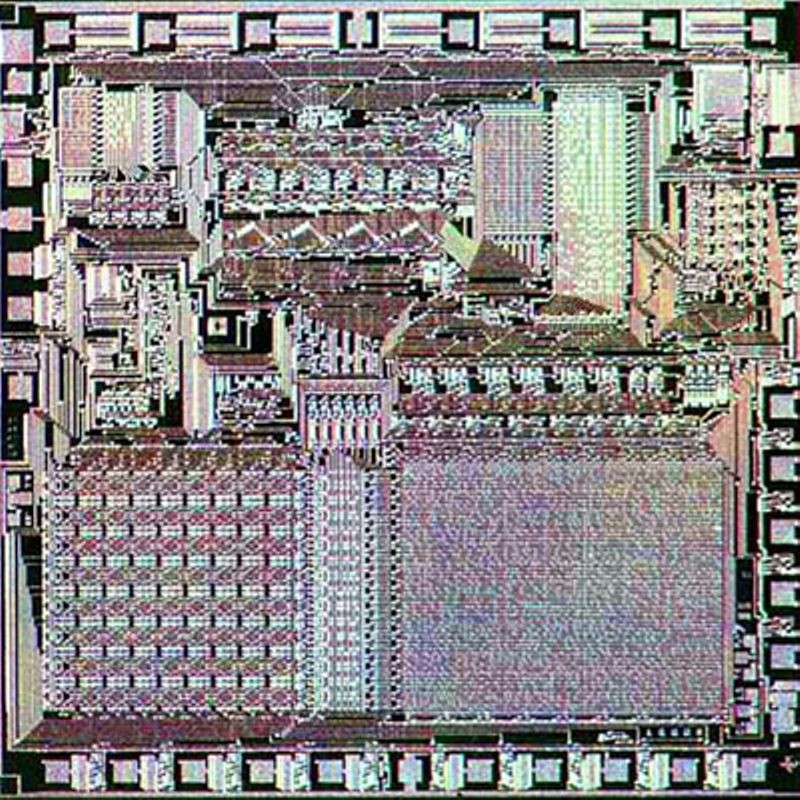
This led to the concept of the single-chip computer, which still forms the basis of modern MCUs today. This integration created a fundamental difference from microprocessor architecture: integrated program memory and volatile memory to operate it without additional memory chips. This allowed electronic control units to be built significantly smaller and more robust, greatly expanding the application scope of microprocessors.
RAM and ROM
A key feature is the integration of RAM and program memory on the same chip as the CPU.
The program memory contains the system's firmware. In early products, Mask ROM was typically used for this. In this method, the program was permanently written into the memory during chip production and could not be changed afterward. This method was suitable for mass-produced products but was inflexible in development. In parallel, classic MCUs contain working memory to provide space for variables, the stack, data buffers, and intermediate results during program execution. RAM is volatile and loses its contents when the power supply is switched off.
RAM
RAM is a volatile memory whose contents are lost as soon as the power supply is switched off. Within the RAM family, there are two important types: SRAM (Static RAM) and DRAM (Dynamic RAM). SRAM stores data stably as long as power is supplied and offers very short access times. Therefore, SRAM is often used in microcontrollers or as cache memory. DRAM, on the other hand, only stores data for a few milliseconds and must be regularly refreshed through so-called refresh cycles. However, DRAM is significantly cheaper per memory cell and is therefore suitable for large main memories in computers.
The Texas Instruments TMS1000 used Dynamic RAM (DRAM) for its integrated 256-bit data memory. This made technical sense for early MCUs because DRAM offers significantly higher memory density at a smaller chip area than SRAM. In the early 1970s, silicon area was very expensive, so memory architectures were heavily optimized for minimal transistor counts.
ROM
In contrast, ROM belongs to the group of non-volatile memory, which permanently retain data even without a power supply. The simplest form is Mask ROM, where the data is permanently integrated into the memory during chip manufacturing. A more flexible variant is PROM (Programmable ROM), which can be programmed once retrospectively. EPROM (Erasable Programmable ROM), on the other hand, allows for multiple programming cycles, with the memory being erased by ultraviolet light.
With the further development of storage technology, so-called hybrid storage emerged, combining the properties of RAM and ROM. EEPROM can be electrically erased and reprogrammed and is often used for configuration data. Flash memory is a further development of this and enables high storage densities at low cost, which is why it is now used as program memory in many controllers. Another variant is NVRAM, where an SRAM is buffered by a battery, so that the data is retained even without power.
The Motorola MC68HC805 is considered one of the first controllers to use EEPROM as program memory for firmware. This marked an important technological step in the development of embedded systems. It now became possible to change firmware more frequently during development and to produce smaller series more economically.
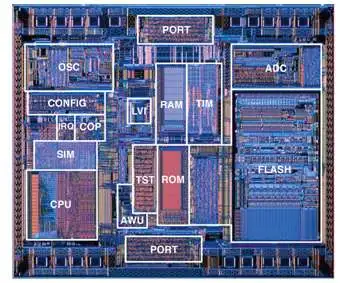
While EEPROM was slower and more expensive than Mask ROM, it offered significantly more flexibility. This technology paved the way for modern microcontroller architectures, where Flash memory is now mostly used as program memory.
Flash-based architectures
Starting in the 1990s, flash memory became established as program memory in microcontrollers. Flash can be electrically erased and reprogrammed, allowing firmware to be updated during development or even later in the field.
This feature fundamentally changed the development of embedded systems. Developers could modify programs multiple times without having to manufacture new chips. At the same time, the possibility was created to control devices remotely Bootloader or provide update mechanisms with new firmware.
The first commercial MCUs with integrated Flash program memory were the Atmel AT89C51 and the Hitachi H8/538F. The AT89C51 was based on the popular 8051 architecture. In parallel, the Hitachi H8/538F represented a significant advancement in the 16-bit segment. The architecture was developed by Hitachi as F-ZTAT is designated. These microcontrollers already integrated larger flash memories – for example, up to 60 kB of program memory – and were primarily aimed at industrial applications.
Programmable ports and pins
The connections of a controller chip are called pins. The microcontroller communicates with the outside world via these pins, for example with sensors, actuators, or other electronic modules. The basic function of a pin is to input or output digital signals.
To simplify control, multiple pins are grouped into so-called ports. Ports are supplied individually with voltage and clock. Additionally, control functions are grouped in programmable registers. A microcontroller pin can usually be configured for multiple functions. The most important programmable properties are:
- Direction (input or output) - whether a pin functions as an input or output
- State – which logical value (0 or 1) is output
- Protocol Function – Alternative Functions such as UART, SPI, I²C etc.
Role in Embedded Systems
Microcontrollers are among the most widely used integrated circuits worldwide today. They are used in almost all electronic devices that perform control or regulation tasks.
Typical applications include:
- Industrial controls
- Household appliances like washing machines or coffee makers
- Sensor and Measuring Systems
- Vehicle control units
- Communication devices
- Medical technology
- military and security-critical systems
MCUs form the heart of many devices Embedded Systems. The firmware controls hardware components, processes sensor data, or regulates physical processes.
Through the tight integration of CPU, RAM, program memory, and peripherals, an MCU can enable very deterministic systems. These characteristics are particularly important for real-time applications, industrial control, or safety-critical electronics.