Embedded
Systems

We develop custom embedded hardware and software – for industry, special applications, and safety-critical systems. With technical depth and cross-industry experience, we support your project from the initial design to market readiness – or specifically strengthen your internal team with our expertise.
What are Embedded Systems?
Embedded systems are specialized computer systems integrated into devices or machines to perform a specific function. Unlike general-purpose computers like PCs or smartphones, embedded systems typically operate in real-time, with significantly limited resources, and under demanding conditions. They are essential for products and applications requiring automation, monitoring, and control.
Typical industries and applications:
Embedded Systems from our Hands
Embedded systems take on clearly defined functions in devices, machines, and complex technical systems. Depending on the intended use, architecture, performance, and security requirements vary considerably. PICKPLACE supports customers in the development of all types of electronics from scratch. What are examples of embedded systems?
Electronic Control Units (ECUs)
Control units regulate functions in vehicle technology, industrial electronics, or rail applications. They control sensors, actuators, or entire subsystems, handle power switching, and are often deeply integrated into safety-relevant processes.
Signal processing, converters & sensor technology
These systems capture and process data from the environment—such as from temperature, light, or motion sensors. This also includes image processing and embedded video processing. The systems handle filtering, transformation, or data classification.
Gateways & Communication
Gateways connect systems to networks or other subsystems. They master classic protocols (CAN, Ethernet, Modbus) as well as wireless communication such as WLAN, NFC or cellular – often with requirements for latency, security, and interoperability.
Control, Automation & Power Electronics
These systems control physical quantities such as pressure, current, or rotational speed – often in conjunction with inverter or converter units. They are central to machine control, network management, or drive control – with requirements for real-time performance and EMC.
Mission-critical systems
A safety-critical embedded system fulfills additional requirements for error prevention, self-monitoring, and structural redundancy. Safety-by-design, safe states in case of failure, and standards-compliant development processes are key features.
Information & Entertainment Systems
These systems are used for playback, data display, or device control – in vehicles, machines, or public applications. They include audio and video applications, as well as network and storage functions.
Embedded systems are the invisible backbone of modern technology – they control, secure, and connect our world, often without us realizing it.
Dr. Hendrik Schnack
Embedded Frequently Asked Questions (FAQ)
Embedded systems are specialized electronic computer systems that are integrated into a technical product and perform a clearly defined task there. They usually work invisibly to the user, but control, measure, regulate, monitor, or communicate in the background. Examples include control units, sensor modules, measuring devices, drive controllers, medical devices, household appliances, or industrial machine modules.
A classic computer is universally applicable. It can run many different programs and is operated directly by the user. An embedded system, on the other hand, is designed for a specific function. It is part of a larger product and performs a technical task there. It often works with limited memory, limited processing power, fixed interfaces, and defined timing constraints.
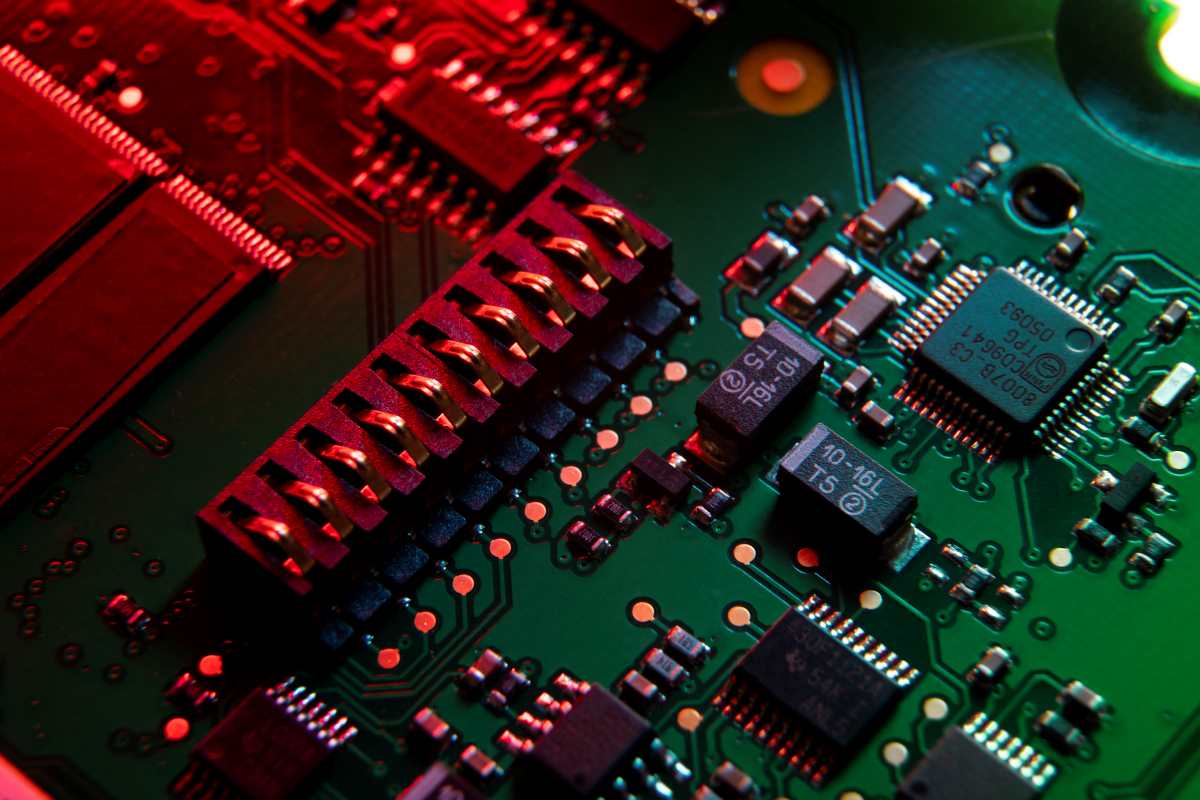
Typical components are a Microcontroller or microprocessor, memory, sensors, actuators, communication interfaces, power supply, protective circuitry, and firmware. Depending on the application, additional components are included, such as radio modules, displays, FPGAs, power electronics, diagnostic interfaces, or external memory chips.
Much of the technology of embedded systems is based on standardized chip architectures for processors and controllers. The most important role in this is played by ARM. ARM primarily provides processor architectures and IP cores. Many semiconductor manufacturers license this technology and build their own microcontrollers, microprocessors, or SoCs based on it. In practice, this means: the CPU core can be based on an ARM Cortex architecture, for example, while memory, peripherals, security features, analog technology, and interfaces are integrated by the respective chip manufacturer.
Among the well-known manufacturers are NXP, Texas Instruments, Infineon, STMicroelectronics and Renesas. They offer microcontroller families for different requirements: simple control tasks, low-power applications, automotive, industrial automation, motor control, radio communication, Safety applications or security features.
Yes. In a technical sense, a PLC is an embedded system. It is a specialized computer system that takes on control tasks in machines and facilities: reading inputs, executing logic, switching outputs, and communicating with sensors, actuators, or control systems. The difference: a PLC is standardized for industrial automation, built robustly, and usually programmable according to IEC 61131-3. Other embedded systems are often more tailored to a single product.
An embedded engineer develops software and electronics for technical devices. They work with microcontrollers, sensors, actuators, and interfaces. Typical tasks include firmware development, driver programming, hardware commissioning, debugging, testing, and error analysis. In short: they ensure that hardware and software in the product work together reliably.
PCB development is a central part of many embedded projects. Firmware does not run in isolation, but on concrete hardware: microcontrollers, memory, sensors, power supplies, interfaces, and protection circuits must be brought together on a printed circuit board. This includes schematic development, component selection, PCB layout, prototype construction, commissioning, and testing. Timing, EMC, signal quality, power supply, and debugging capabilities, in particular, strongly depend on the PCB design. In short: embedded engineering almost always means understanding the target hardware. In many projects, the PCB is co-developed or at least closely coordinated with firmware development.
Embedded Systems Engineering is the development of complete embedded electronic systems – not just firmware, but the interplay of hardware, board, software, and system requirements.
This typically includes:
- Schematic development, component selection, and PCB layout
- Microcontroller, Processor, or FPGA Selection
- Firmware and Driver Development
- Interfaces such as CAN, Ethernet, SPI, I²C, or UART
- Sensors, Actuators, and Power Supply
- Commissioning, Debugging, and Testing
- EMV, Functional Safety, Cyber Security, and Documentation
In short: Embedded Systems Engineering ensures that requirements are turned into a functioning electronic product – from architecture and the circuit board to firmware.