What is an FPGA?
An FPGA (Field-Programmable Gate Array) is an integrated circuit whose internal logic structure can be configured by the user after manufacturing. Unlike microcontrollers or processors, where a program is executed sequentially on a CPU, an FPGA implements digital hardware structures directly on the chip.
An FPGA consists of a large number of configurable logic blocks, memory structures, and programmable interconnects. A so-called configuration file (bitstream) determines how these logic blocks are interconnected and what functions they implement. This allows developers to realize, for example, digital signal processing, communication interfaces, or complete hardware accelerators.
FPGA Logic Development
Development for Field-Programmable Gate Arrays (FPGAs) is typically done not with classic programming languages, but with Hardware Description Languages (HDLs) like VHDL or Verilog. This does not describe a program flow, but rather a hardware structure that is subsequently implemented.
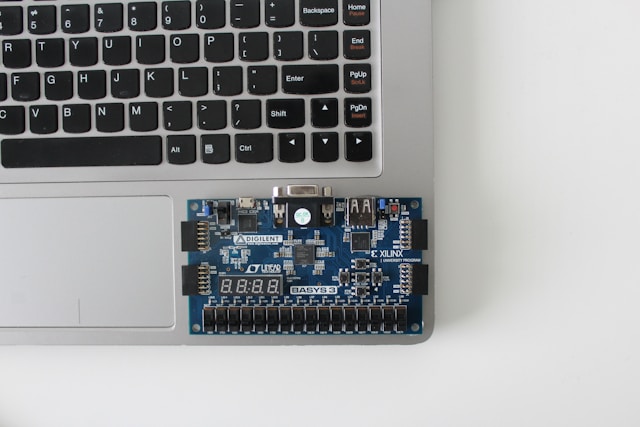
FPGAs are often used when parallel data processing, high data rates, or special hardware functions are required. Typical application areas include industrial controls, signal processing, communication systems, measurement technology, and image processing.
Unlike an ASIC (Application-Specific Integrated Circuit), an FPGA remains reconfigurable after manufacturing. This makes it particularly suitable for prototypes, flexible hardware platforms, or systems where functions can be changed or expanded in the field.
Areas of application
Typical application areas include power electronics, GHz logic, communication protocols, and camera systems. In power electronics, FPGAs are used, for instance, for fast control algorithms. In communication systems, they can implement complex protocols or signal processing in hardware. For cameras and image processing systems, they enable the parallel processing of large data streams directly at the sensor.
One disadvantage is the high development effort. Development is usually done with hardware description languages and requires specialized expertise in digital circuit technology, timing, and hardware architecture. Furthermore, powerful FPGA systems can have significant power consumption, especially when large logic areas or high clock frequencies are used.
Manufacturer
Some FPGA manufacturers:
- AMD (Xilinx) – https://www.amd.com
One of the largest global providers with series such as Virtex, Kintex, Artix, and Zynq. - Intel (formerly Altera) – https://www.intel.com
Offers families such as Stratix, Agilex, Arria, or Cyclone, and is one of the two dominant suppliers in the market. - Lattice Semiconductor – https://www.latticesemi.com
Specializing in power-saving FPGAs and CPLDs - Microchip Technology (formerly Microsemi / Actel) – https://www.microchip.com
Known for safety and reliability-oriented chips like PolarFire or ProASIC.