
In the railway industry, safety is of the utmost importance – especially when developing electronic systems that are essential for train operations and signaling technology. This particularly affects safety-critical electronics. Rail industry and rail traffic mean not only flawless function, but also reliable adherence to strict standards and norms.
Development Process for Electronic Systems in Rail Transport
To ensure the security of customer hardware and software in the railway context as a service provider, several fundamental aspects should be considered: a standardized development process, a clear requirements structure, thorough validation measures, special security methods in hardware development, and awareness of industry-specific standards.
A standardized development process is mandatory for electronics projects in the rail industry – regardless of the target Safety Integrity Level (SIL). The Safety Integrity Level specifies how reliable safety-related functions must be, ranging from SIL 1 to SIL 4 (highest level). In principle, every project should follow an established process based on the V-model. The V-model is a development model where requirements and specifications are gradually refined from coarse to detailed on the left side, while corresponding test levels on the right side ensure that each implementation meets the predefined requirements. Starting from customer requirements, specifications are increasingly detailed on the left until implementation can occur. Each implementation is then verified against the previously defined specifications through corresponding test steps. This iterative approach ensures that systematic errors are identified and corrected early on.
For safety-critical (FuSi) projects, the process prescribes additional evidence and documentation. The effort increases with rising SIL: more measures for error prevention and error control must be taken, and more extensive documentation must be maintained. For example, higher SIL levels often require independent reviews and audits at important milestones to ensure that all safety requirements are met. Overall, a standards-compliant development process should be established from the outset, satisfying both industry-specific standards (e.g., the European CENELEC EN 5012x series for railway applications) and quality management standards. The result is a reproducible process that delivers consistent quality and safety for every electronics project, regardless of the SIL.
Electronics & Rail Industry: Validation and Verification
The validation of electronic railway systems encompasses all measures that ensure the developed system meets the specified requirements and functions safely in real-world operation. Several levels of tests and checks are distinguished along the V-model: module tests, integration tests (hardware-software integration), and system tests, up to the acceptance test. These are each assigned to the specifications on the left side of the V-model on the right side.
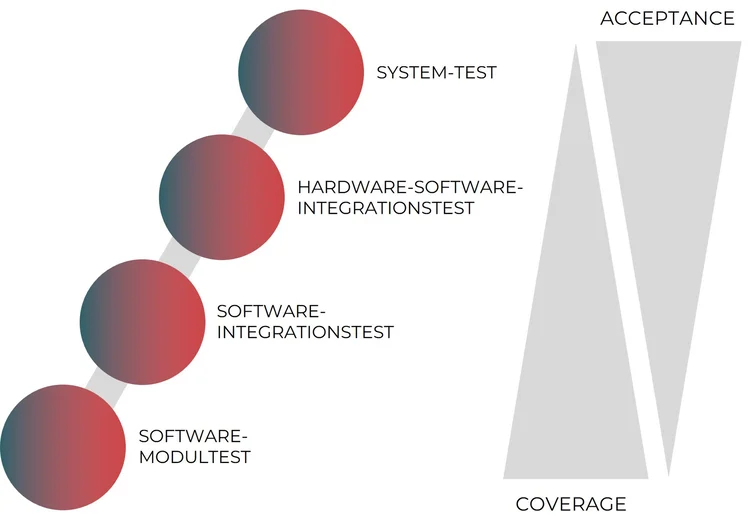
In the early stages of development – such as with software module tests or initial hardware prototypes – the focus is on verification, code quality, and coverage. This means ensuring that, for example, software code achieves high test coverage through unit tests, and critical paths as well as error cases are specifically tested. Static code checks and reviews also belong here. In hardware, circuit components are checked for functionality at an early stage (e.g., via simulation or on a test bench) to achieve maximum error coverage.
As integration increases, the focus shifts to acceptance and functionality. At the assembly and system level, it is checked whether all components function together as intended (integration test) and, ultimately, whether the overall system meets the original customer requirements (system test and acceptance). Functional tests are at the forefront here: real operating conditions are simulated to validate that the system reacts safely and reliably fulfills all safety functions. A good verification and validation concept is crucial so that all necessary tests are planned, documented, and carried out seamlessly. Only then can a certifiable system be achieved at the end, which can prove its safety and function at any time. It is advisable to create a detailed V&V plan at the beginning of the project, which defines responsibilities, test methods (e.g., black-box tests, fault injection tests), and success criteria for each project phase.
Safety-Hardware Approach in Development
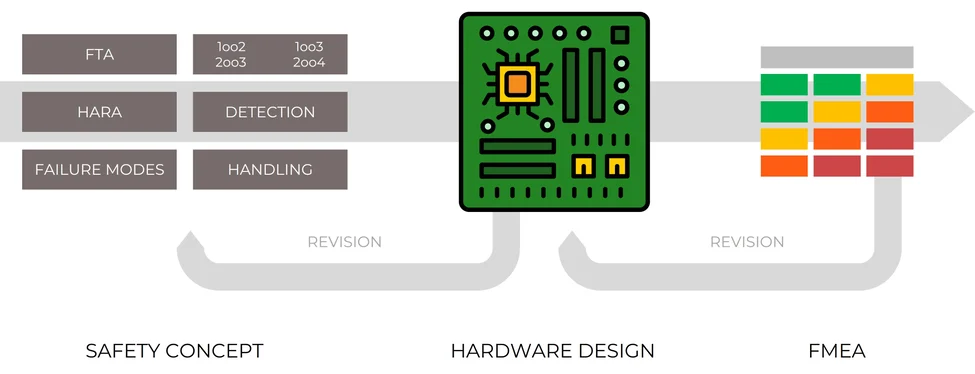
Electronic components in safety-critical rail applications (e.g., signaling controls, train control systems) require a special safety hardware approach. Dedicated safety analyses should be performed from the outset to identify potential risks early on. During the conceptual phase of a project, a Hazard Analysis and Risk Assessment (HARA) is typically conducted, where all potential hazards that could emanate from the system are identified. Based on the HARA, a Safety Concept is created: This defines safety goals and requirements that the system must adhere to in order to manage risks. Methods such as FTA (Fault Tree Analysis) are often used here to work backward from a potential accident event to determine all combinations of faults that could lead to it. This creates a picture of the necessary safety mechanisms and architectural measures (e.g., redundancies, monitoring) to eliminate or manage single points of failure.
In the following hardware design and implementation phase, detailed analyses such as FMEA (Failure Mode and Effects Analysis) are carried out. An FMEA systematically examines every conceivable component and failure mode for its effects, particularly with regard to safety. The goal is to uncover weaknesses and adapt the design so that no single failure can lead to an uncontrolled hazardous state. For quantitative safety proofs, Probabilistic Risk Assessment is often used, especially the PFH metric. The PFH value indicates the average probability of a dangerous failure per hour (Probability of a Dangerous Failure per Hour) – it is therefore a measure of the reliability of a safety function. Based on the component failure rates, an expected PFH value for the overall system can be calculated. This must be below the limit value required for the target SIL. If the calculated failure probability does not meet the specified limits, the design must be revised until the requirements are met. In practice, this often means several design and concept reviews, during which independent experts examine the hardware design. Therefore, sufficient iterations and buffers should be included in the development plan to allow for architectural or component changes if necessary. Only when all analyses (HARA, FTA, FMEA, etc.) and calculations show that the safety goals have been achieved is the transition to the realization phase made. This early and iterative safety approach ensures that all necessary safety evidence is available before production begins and that the system complies with the strict rail safety standards.
Development of Electronics – Railway Industry Standards
In the railway industry, standards such as EN 50126, EN 50129, EN 50155, and EN 50716 form the foundation for the development of safe and reliable electronic systems. EN 50126 defines the overarching RAMS-process throughout the entire lifecycle, while EN 50129 sets concrete requirements for the safety verification of electronic systems. EN 50155 regulates the environmental and operating requirements for electronics on board railway vehicles, thus ensuring robustness in real-world operation. EN 50716 harmonizes and modernizes software development in the railway context, integrating modern development approaches such as agile methods for the first time. Furthermore, the increasing relevance of cybersecurity is emphasized, with complementary specifications such as TS 50701 must be used. Taken together, these standards enable a structured, traceable, and future-proof development of track-suitable electronics solutions.
The special feature from the railway's perspective in the standards is the defined RAMS (Reliability, Availability, Maintainability, and Safety) reference. The central standard EN 50126 makes this RAMS process binding for the railway industry. It requires that reliability, availability, maintainability, and safety for railway systems be systematically specified and proven in all relevant lifecycle phases. In practice, this means, for example, that formal risk analyses (such as hazard and failure analyses like HAZOP or FMEA) are carried out at an early stage to assess weaknesses and hazards. Subsequently, the required reliability is demonstrated through calculations (e.g., failure rate and availability analyses) and tests, so that the specified RAMS targets are met. For the calculation of failure rates for electronics, theoretical calculations (FIT and FTA) are also possible. Through all these measures, the RAMS process ensures that railway systems can be operated reliably and safely while remaining economically viable over their lifecycle.
Special features of the railway industry
Despite processes and methods, railway projects face some particular challenges that need to be overcome:
High Complexity and Parallel Projects: Railway projects are often extremely complex and run in parallel. A variety of projects, such as vehicle modernization, new signaling systems, and infrastructure upgrades, tie up resources simultaneously. Therefore, good project and resource planning should be established to maintain an overview. The complexity also increases communication efforts between teams and requires strict configuration management to ensure that safety requirements are consistently implemented across all subprojects. Furthermore, tenders in the railway industry can lead to peak workloads: If a company wins a large contract, high development effort arises suddenly, while phases of lower utilization lie between such projects. This irregular, peak-driven business presents further challenges for resource management – buffers should be planned and flexible action taken to absorb peak loads.
Regulatory pressure and proof of compliance: The railway industry is heavily regulated. National and international authorities require detailed proof that all safety standards are met. This leads to a high documentation effort: every requirement, every test, and every design change must be clearly documented and often approved by an independent body. For companies, this means considerable effort in maintaining safety certifications (e.g., safety case documents according to CENELEC standards) and in communicating with assessors or approval authorities. A compliance strategy should be developed early on to efficiently achieve the necessary certifications and regulatory approvals without stalling the project.
Resource scarcity and the skills shortage: Skilled professionals for functional safety and electronics development are in demand and often scarce. Rail projects regularly struggle with a chronic understaffing of specialized roles – such as safety engineers, test experts, or RAMS managers. At the same time, safety projects require a lot of personnel over long periods, which leads to bottlenecks. This should be actively countered, e.g., through further training of existing employees, attractive conditions for specialists, and, if necessary, partnership models with external experts. Furthermore, efficient multi-project management is necessary to optimally allocate existing specialists to projects without risking a loss of quality.
Obsolescence issue: A particular problem in electronics for railways is the short lifespan of many components compared to the lifespan of trains or systems. Electronic componentsMicrocontroller, Chips and memory often have product lifecycles of only a few years, while rail vehicles are in service for several decades. This creates the challenge that components become obsolete (no longer available) long before the system is decommissioned. Therefore, an obsolescence strategy should be planned early on: on the one hand, selecting components with long availability or second sources; on the other hand, timely last-time buys (last major purchases of end-of-life components) and the establishment of a spare parts pool, if necessary. Additionally, existing stock must be managed – for example, by stocking critical components and regularly reviewing which parts can be replaced by new, compatible components. Obsolescence management is a continuous process throughout the entire lifecycle of a rail electronics system, which is essential to ensure safe operational readiness for decades.
Conclusion
Developing secure electronics for the railway industry requires a structured approach and extensive expertise. From initial planning and specifications to validation and certification, a holistic safety approach must be pursued. Standardized processes, coupled with disciplined requirements management and thorough testing, form the backbone of successful projects. Additionally, special methods like HARA, FTA, and FMEA safeguard hardware designs against risks. At the same time, industry-specific hurdles such as limited resources, strict regulations, and technical Obsolescence do not underestimate. Technologically savvy decision-makers in the rail sector should always keep these aspects in mind. One should plan proactively, incorporate buffers for security issues, and create a climate where quality takes precedence over deadline pressure. This will ensure that electronic systems in rail projects not only function but, above all, operate safely and reliably – to protect lives and ensure smooth rail traffic.