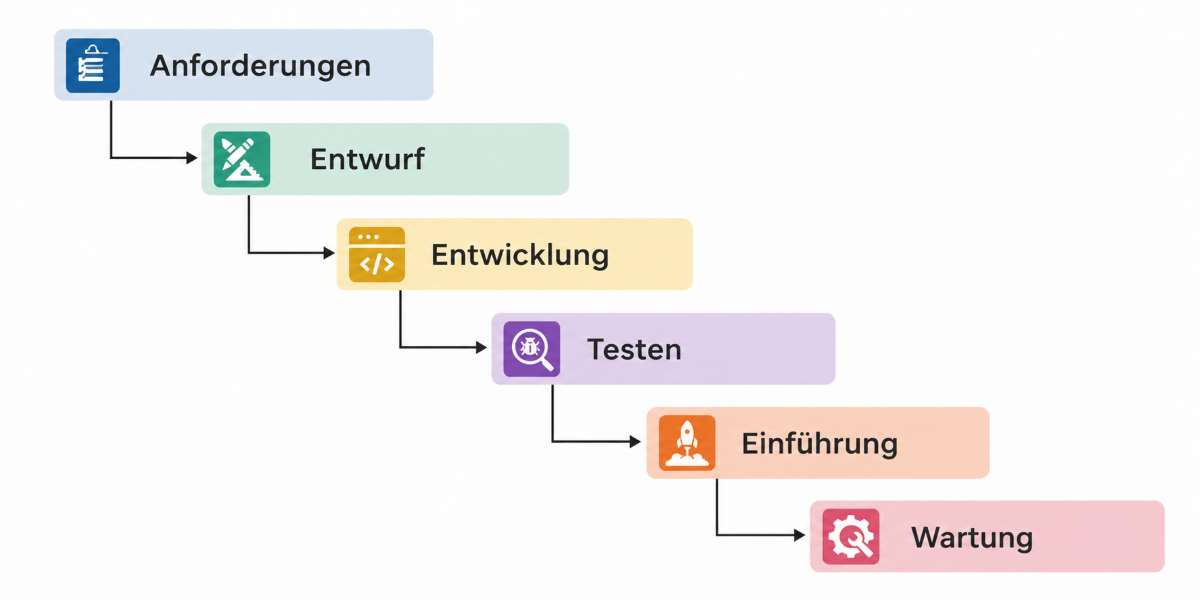
The waterfall model is a classic, linear process model in project management, particularly in software and system development, based on a strictly sequential execution of project phases. The fundamental idea is that a development process is divided into clearly defined phases, each of which must be fully completed before the next begins. Typically, this flow includes the steps of requirements analysis, system design, implementation, testing, and delivery and maintenance. Each of these phases produces defined results, often in the form of extensive documentation, which serves as a binding basis for subsequent steps. The model's name is derived from the visual representation of this sequence, where the phases follow each other like cascades of a waterfall, and results are „passed down.“.
Content
Characteristics of the Waterfall Model
Document orientation
A strong document orientation is characteristic of the waterfall model. At the end of each phase, there is a formally verifiable artifact, such as a requirements specification, a design specification, architectural or design descriptions, test logs, or release documents. These documents not only fulfill a technical function but also serve for management, control, and record-keeping within the project. This results in a high degree of formalization, which is considered an advantage, especially in regulated environments. At the same time, this documentation burden leads to considerable overhead, particularly in projects with dynamic or unclear requirements.
Historically, the waterfall model did not originate in software development but in classical engineering disciplines such as construction or industrial manufacturing. In these fields, it is common for requirements to be largely defined completely at an early stage, and later changes are associated with high costs or risks. This paradigm was adopted in the early days of software development when there were hardly any established processes or methodological standards.
Winston W. Royce plays a central role in the historical classification, with his 1970 publication often cited as the origin of the waterfall model. Interestingly, Royce himself did not describe the linear model as a best practice; rather, he explicitly pointed out its weaknesses and already suggested iterative elements such as early prototypes and continuous customer involvement. However, later interpretations of his work often reduced this nuanced view to the simplified, strictly linear model.
Underlying Assumption: Consistency of Requirements
A key characteristic of the waterfall model is the assumption that requirements can be fully, consistently, and stably captured at the beginning of a project. However, this assumption often proves unsustainable in practice, especially in software development, where requirements are influenced by technological advancements, market changes, or new insights during the project. The consequence is that changes occurring after the completion of the requirements phase are difficult to integrate. Since each phase builds upon the results of the previous one, adjustments often lead to complex rollbacks that can delay and increase the cost of the entire project.
Another critical point is the temporal structure of the model. Since functioning subsystems are only created relatively late in the project, the validation of the overall system also occurs late. Errors or incorrect assumptions often only become visible during the integration or testing phase, at a time when corrections are particularly complex. This so-called „late feedback“ effect is one of the main reasons why the waterfall model is considered problematic in many modern development environments. In contrast, newer approaches focus on early and continuous validation to identify and reduce risks early on.
The linear structure also leads to a so-called „Big Bang“ Integration Approach. Individual components are developed independently and only merged at the end. This significantly increases the risk of integration problems, as interfaces, assumptions, and dependencies have often not been sufficiently tested. In complex systems, this can lead to significant delays, especially if fundamental architectural decisions need to be revised.
Reasons for the Waterfall Model
Despite these disadvantages, the Waterfall model offers some characteristics that are still considered advantageous in certain contexts. The clear structuring of phases allows for relatively simple planning and control of project progress. Milestones are clearly defined, and progress can be tracked based on completed documents. This particularly facilitates communication with stakeholders who are not deeply involved in the technical details. Furthermore, the early definition of requirements allows for a comparatively precise estimation of costs and resources, at least under the assumption of stable framework conditions.
Another aspect is the traceability and auditability of the development process. In highly regulated industries, such as aerospace, medical technology, or in Defense sector, detailed documentation and formal approvals are mandatory. This is where the waterfall model plays to its strengths, as it allows for a clear assignment of requirements, design decisions, and implementations. Every decision can be documented and later reviewed, which is essential for certification processes and compliance requirements.
However, it also shows that these advantages are outweighed by disadvantages in many other areas. In particular, the necessary flexibility is not present in dynamic markets or innovation-driven projects. The inability to react quickly to new findings means that developed systems can already be obsolete by the time they are completed. This is particularly critical in software development, where technologies, requirements, and user expectations change rapidly.
Usage
For this reason, the Waterfall model is considered outdated in many areas today. The IT industry has developed a multitude of alternative process models in recent decades that are based on iteration, incrementality, and continuous feedback. These include, among others, agile methods such as SCRUM or Extreme Programming, but also more structured approaches such as the Spiral model or the Rational Unified Process. These models specifically address the weaknesses of the Waterfall model by promoting short development cycles, early prototypes, and close collaboration with the customer.
Nevertheless, the waterfall model has not completely disappeared. It continues to be applied in specific domains where the framework conditions favor its structure. This is particularly relevant in the areas of public safety, defense, critical infrastructure, and parts of aerospace. In these areas, aspects such as traceability, certification, security clearances, and regulatory requirements are paramount. Changes must be controlled, documented, and verifiable, which complicates iterative and flexible approaches. Here, the waterfall model offers a structure that meets formal requirements, even if it comes at the cost of flexibility and speed.
Another reason for its continued use in these areas is long-term planning security. Projects in the public sector or in security-critical applications often have long durations and high investment volumes. Detailed planning at the outset is necessary to justify budgets and secure political or organizational decisions. The waterfall model provides a suitable framework for this, even if it is not optimal from a technical perspective.
In today's practice, the waterfall model is primarily found in traditionally oriented and highly regulated sectors such as defense, marine, energy systems, and classic utilities. This applies wherever projects are planned long-term, requirements are relatively stable, and extensive documentation and traceability to authorities or clients are absolutely necessary. In essence, anywhere close to the construction industry or within the public sector, especially in the context of tenders and procurement.
Requirements are contractually fixed early on, services are described in detail, and changes involve considerable organizational and legal effort, which structurally favors a sequential, document-driven approach. The separation of phases aligns with classic procurement procedures, where specification, bid, implementation, and acceptance are strictly separated. It's no coincidence that standards like MIL 498 this strongly document-oriented approach.
Summary
In summary, the waterfall model played a historically significant role in the development of process models, but today it is considered outdated in many contexts. Some authors even argue„The waterfall methodology is always bad„Its strengths lie in structuring, documentation, and traceability, while its weaknesses are particularly in its lack of flexibility and late error detection. In modern development environments characterized by uncertainty, complexity, and rapid changes, iterative and adaptive approaches have largely prevailed. However, the waterfall model remains relevant in certain niches, especially where formal processes, regulatory requirements, and stable frameworks play a greater role than speed and adaptability.
Zurück zum Glossar