STM32 is a family of 32-bitMicrocontroller based on the ARM Cortex-M architecture, which is characterized by widespread adoption, a large developer base, and consistent scalability within a unified embedded platform.
Content
About STMicroelectronics
STMicroelectronics is a European semiconductor manufacturer with roots in the merger of SGS Microelettronica (Italy) and the semiconductor division of Thomson (France). The company is one of the major providers in the field of integrated circuits and addresses applications in industry, automotive, medical technology, and embedded systems.
In the microcontroller sector, ST has pursued a strategy of broad platform coverage for many years. The goal is not specialization in individual niches, but rather the provision of a consistent, scalable architecture across many performance and application classes. STM32Family is the central outcome of this strategy.
ST's first 32-bit processor
Before the introduction ST already on 32-bit microcontrollers based on older ARM cores such as ARM7 and ARM9. However, these platforms were less consistently structured and more fragmented, both in terms of software and peripherals.
With the licensing of ARM Cortex-M cores in the mid-2000s, the foundation for a new generation was laid. The goal was a unified microcontroller family that could scale across different performance levels without forcing fundamental architectural changes.
The first very widespread 32-bit series was the F1 series with a Cortex-M3 core, introduced in 2007. It formed the starting point for the further development of the platform and defined essential concepts that have been maintained to this day, particularly the combination of a standardized CPU core and manufacturer-specific peripheral integration.
Introduction STM32
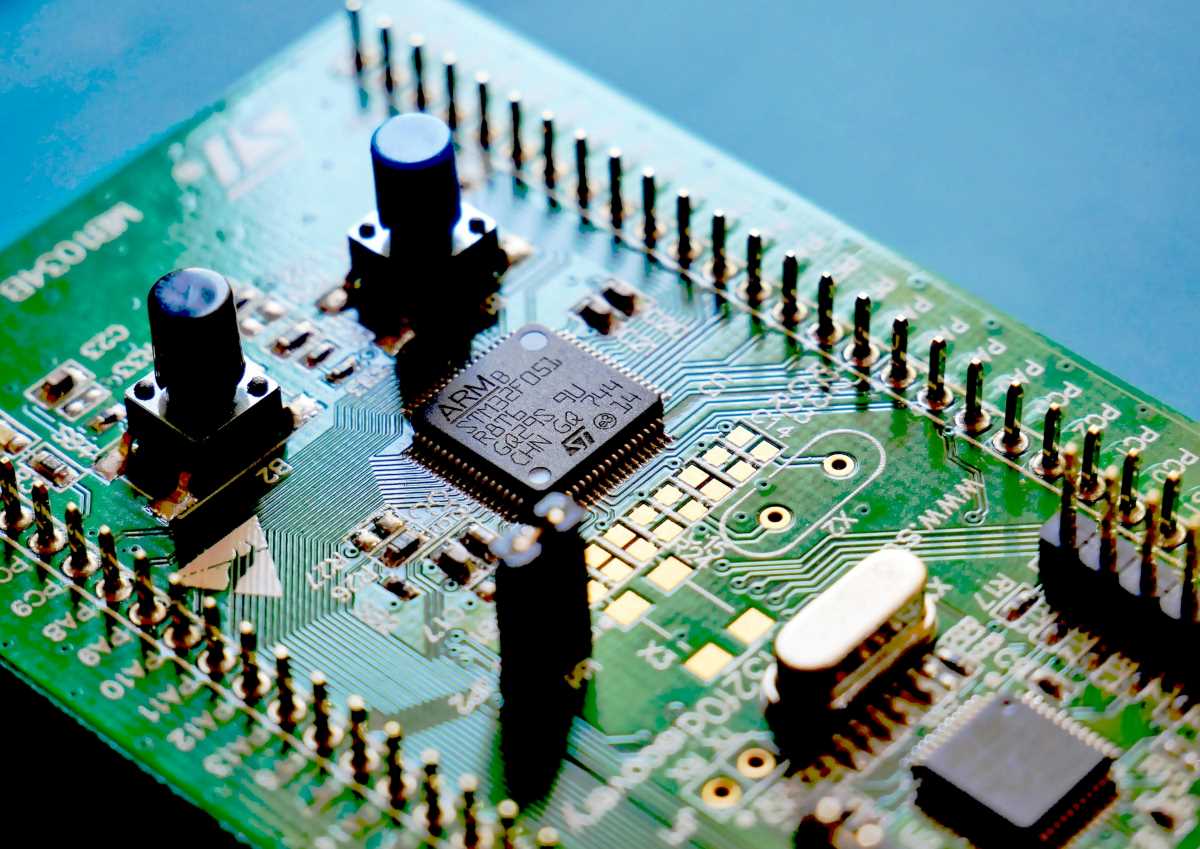
STM32 refers to a family of 32-bit microcontrollers based on ARM Cortex-M core architectures. The Microcontroller are designed as general-purpose systems and integrate CPU, memory, and a variety of peripheral functions on a single chip.
STM32 microcontrollers typically consist of a Cortex-M core, internal flash memory for program execution, SRAM for runtime data, and extensive peripherals. These include digital inputs and outputs, timer structures, communication interfaces like UART, SPI, or I²C, and analog components such as ADCs or DACs. This is supplemented by an interrupt system (NVIC), clock management, and debug interfaces.
What is essential is not the individual functional unit, but the integration and interplay within a system. The microcontroller is designed to control hardware directly and deterministically, without relying on external components or complex operating systems.
Distribution and Significance
STM32 is one of the most widely used microcontroller platforms in Embedded-area. These building blocks are used in a wide range of industrial applications and have become established as a standard in many areas. This widespread adoption is not primarily the result of individual technical unique selling propositions, but rather arises from the combination of availability, consistency, and practical usability.
A key factor is the large developer base. Many engineers come into contact with the platform early on. After simple entry-level systems like Raspberry Pi or platforms like Arduino, ST's MCUs represent the transition to classic embedded development for many. This creates a broad foundation of existing knowledge, sample projects, and experience, which further favors their use in industrial projects.
The platform thus benefits greatly from network effects. The more projects and developers rely on STM32, the more obvious the decision becomes for new projects to also adopt this architecture.
Architecture and Series Structure
The STM32 family includes a variety of series that differ in performance, power consumption, and feature set. These series are based on different Cortex-M cores, including M0, M3, M4, M7, and newer variants with advanced security or computing features.
The structure is designed so that systems can scale along multiple dimensions. These include computing power, memory size, peripheral equipment, and power consumption. Despite these differences, the fundamental architecture remains consistent. This particularly applies to the programming model, register structure, and basic peripheral concepts.
This consistency is a central component of the platform. It allows designs to be further developed within a family without having to make fundamental changes to the software or system architecture.
Software and Development
Programming ST microcontrollers is predominantly done in C or C++. Hardware access is achieved through registers defined in the Reference Manual or through abstraction layers built upon them.
An important component of the platform is the software ecosystem. This includes standardized interfaces like CMSIS as well as libraries provided by ST. These enable structured development and promote code reusability. In practice, this means that drivers or system components developed once can often be reused in other projects.
Development is typically tool-assisted, with configuration, code generation, and debugging being closely intertwined. The documentation is extensive and consists of datasheets, reference manuals, and application notes, which are used as technical reference works.
C
Since the HAL is in C, C is also used as the central programming language in practice, as all hardware connections – including register access, drivers, and libraries like CMSIS, HAL, and LL – are designed for it. In addition, Assembler for use in system-near parts, especially in startup files and during system initialization (reset handler, stack, vector table). C++ is also used in some projects, mostly as a structural extension on top of the existing C base, e.g., by GitHub users tomikaa87 and Suichan4github.
Practical relevance
The significance of ST's 32-bit microcontrollers in everyday engineering stems from several factors. Crucially, the cross-compatibility within the platform is of paramount importance. Different microcontrollers behave structurally similarly, allowing software to be transferred with manageable effort.
Another relevant point is the partial pin compatibility within series or between related derivatives. This allows hardware designs to be adapted without needing to be completely redeveloped. This is particularly useful for variant creation, scaling, or when dealing with Obsolescence of importance.
Furthermore, the high integration density plays a role. Many functions that previously required external modules are now included directly in the microcontroller. This reduces complexity at the system level and simplifies both design and commissioning.
Classification
STM32 is not a platform that defines itself by maximum performance values. Rather, the microcontrollers are designed to be reliably used in a wide range of applications. Their strength lies in the combination of VASTNESS, consistency, and practical manageability. ST controllers are often used where scalable and well-manageable embedded systems are needed. The platform is familiar to many developers, widely accepted in the industry, and offers a solid foundation for a variety of applications.
Zurück zum Glossar