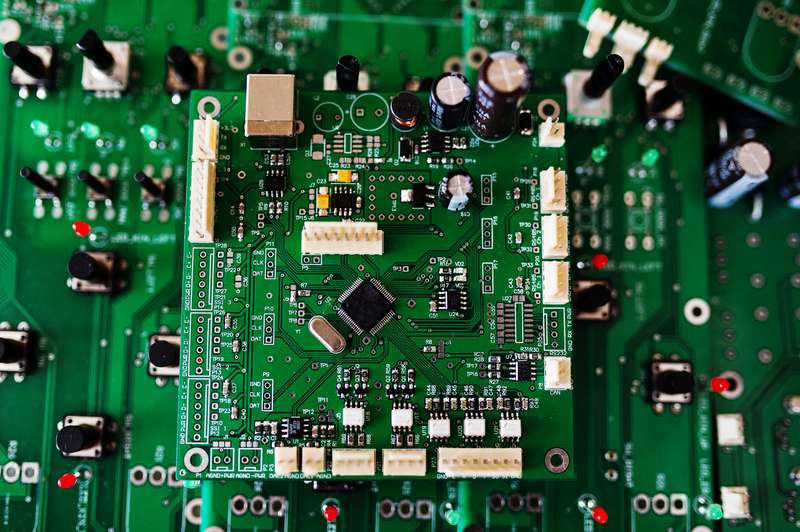
A Eurocard is a standardized printed circuit board (PCB) format for electronic assemblies that has been used in industrial, scientific, and technical applications since the 1970s. The format originated in Europe within the context of modular electronic systems and became established particularly in areas where structured and expandable electronic systems were required. Eurocards are typically inserted into card cages and connected to a backplane via standardized connectors. Multiple cards together form a complete electronic system.
The development of the Europe card fell into a phase of growing complexity in electronic systems. Computer technology, industrial controls, and measurement systems increasingly required modular architectures where individual functions could be implemented on separate modules. Instead of hardwired overall systems, concepts with interchangeable printed circuit boards emerged. This structure simplified the development, integration, and expansion of technical systems.
The classic Europe card has dimensions of 100 mm x 160 mm. This format is frequently referred to as 3U. The height designation is based on the unit system for height, which is also used for 19-inch racks. In addition to the 3U format, larger variants such as 6U with a height of 233.35 mm exist. Furthermore, various width variants and special formats have been introduced, which are oriented towards specific requirements.
The boards are inserted into subracks. These consist of guide rails, support profiles, and a rear backplane. When inserted, the connectors of the Eurocard engage with corresponding counterparts on the backplane. The mechanical design ensures reproducible contacting and eliminates the need for additional wiring.
The backplane forms the central electrical infrastructure of the system. It distributes power supply voltages and signal lines between the individual boards. Depending on the system standard, the backplane can be passive or active. Passive backplanes mainly contain conductors and connector structures. Active variants integrate additional electronic components such as bus controllers or signal conditioning circuits.
Early European card systems often used parallel bus systems. A significant standard was the VMEbus, originally developed for processor systems based on the Motorola 68000 architecture. VMEbus defined the mechanical, electrical, and protocol-related properties of communication between cards. The system found widespread use in industrial controls, real-time systems, and scientific equipment.
Later, other standards such as CompactPCI emerged. This system is based on PCI technology from computer engineering and transfers its architecture to industrial plug-in card systems. CompactPCI also uses Eurocard formats and integrates serial or parallel bus systems via the backplane.
The connectors are an essential component of the Eurocard. Connectors conforming to DIN 41612 are particularly common. These feature defined contact arrangements and various pole counts. The standardized positioning ensures compatibility between cards and subracks from different manufacturers. The connectors transmit supply voltages as well as data and control signals.
The front of the Eurocard is finished with a front panel. This often contains interfaces to the outside world. Typical elements on front panels include Sub-D connectors, BNC sockets, LEDs, switches, or controls. The width of front panels is specified in subunits and also follows a standardized grid.
The European map became particularly strong in industrial applications. In automation technology, modular control systems with interchangeable cards were built. Processor units, digital inputs, analog measurement modules, or communication interfaces could be combined within a common system. This structure met the requirements for complex machine and plant controls.
The European map also played a significant role in measurement technology. Measuring systems often consist of different functional blocks such as signal conditioning, digitalization, data storage, and communication interfaces. The modular design allowed systems to be adapted to different measurement tasks.
In telecommunications, Eurocards were used in switching technology, transmission systems, and network infrastructures. The high packing density and structured integration of multiple cards within a subrack were suitable for complex communication systems with many parallel signal paths.
Military and aviation applications also made extensive use of the format. These required standardized, interchangeable electronic modules with defined mechanics and robust contacting. For example, subrack assemblies with Eurocards were used in radar systems, communication equipment, or aircraft avionics.
The development of a Europe map requires consideration of electrical and functional boundary conditions. The printed circuit board layout is based on the standardized positions of connectors and front panel elements. Integration into existing backplane systems determines many aspects of the PCB design early in the development process.
Multilayer printed circuit boards are common in Eurocard systems. The high signal density and the integration of complex bus systems require multiple copper layers for power, ground, and signal lines. Controlled impedances and defined routing are particularly necessary at high data rates.
Signal integrity plays a central role in modern European map systems. High data rates lead to requirements concerning reflections, crosstalk, and propagation delay differences. The backplane itself becomes a critical high-frequency element. Trace routing, transitions between connectors and printed circuit boards, as well as the electrical quality of the contacts influence the overall system.
Differential signaling is commonly used to reduce electromagnetic interference and enable higher data rates. High-speed serial interfaces impose additional requirements on layout, material selection, and connector quality.
Electromagnetic compatibility is another important factor. European cards are usually located in metallic subracks with a defined grounding structure. PCB layouts are optimized for EMC. Grounding concepts, shielding concepts, and filter structures influence the system's behavior regarding interference emissions and immunity.
The standardization of the Eurocard is closely linked to international standards. The mechanical basis is described in IEC 60297, among others. This standard defines the dimensions of subracks, plug-in units, and front panels. IEEE standards for bus systems such as VMEbus also exist as a supplement.
Standardization enabled the creation of a broad market for compatible components. Manufacturers were able to develop cards, subracks, and backplanes that could be used across systems. This led to the creation of modular ecosystems for industrial electronics systems.
Maintenance of European map systems is typically performed at the module level. Defective cards are identified and replaced. This approach significantly reduces downtime for technical systems. In many applications, spare cards were kept on hand to enable quick responses in case of failure.
Diagnostic mechanisms supported problem localization. LEDs on front panels indicated operating statuses or fault conditions. Test points on the boards enabled electrical analyses during operation. In more complex systems, integrated self-tests were used.
As the integration density of electronic components increased, the role of the Eurocard also changed. Modern systems integrate significantly more functionality onto individual printed circuit boards than early systems from the 1970s or 1980s. At the same time, modular architectures remained relevant in many areas, particularly in long-life industrial and specialized applications.
In embedded systems, eurocards are often used for control computers, FPGA-based signal processing, or communication modules. Especially in applications with long product lifecycles, the interchangeability of individual modules remains an important factor.
Eurocards are also used in the field of testing technology. Automated test systems often consist of modular plug-in cards for measurement functions, stimulus generators, or interface modules. The modular architecture allows for adaptation to different testing requirements.
A related concept is the 19-inch system, which is often used in conjunction with Eurocards. In this system, the subrack is installed in a standardized rack. Several subracks can be combined within a common cabinet. This concept is particularly common in data centers, industrial plants, or telecommunications systems.
The mechanical grid of the front panels is done in modular units. A modular unit typically corresponds to a width of 5.08 mm. This allows different width cards to be combined within a common sub-rack.
Electrical safety is a relevant aspect of Eurocard systems. Supply voltages, grounding concepts, and protective measures against short circuits or incorrect mating must be considered. Many systems have defined insertion sequences or leading contacts for ground connections.
In hot-swap capable systems, cards can be exchanged during operation. This requires special connectors and control mechanisms to avoid voltage interruptions or signal errors. Such concepts are found particularly in telecommunications or server applications.
The manufacturing of Eurocards is done using standard PCB processes. Depending on complexity and requirements, through-holes, blind vias, or buried vias are used. Today, assembly is predominantly done using SMT technology, while older systems often used through-hole components.
The increasing digitization of industrial systems led to the integration of powerful processors and FPGA structures on Eurocards. This resulted in highly complex assemblies with significant computing power within standardized mechanical structures.
The Eurocard is one of the defining concepts of modular electronic architectures in industrial electronics. Its structure combines standardized mechanics, defined electrical interfaces, and interchangeable functional modules within a common system. The format continues to form the basis of numerous industrial, communication, and specialized applications to this day.
Zurück zum Glossar