The term Software Defined Defense (SDD) currently dominates the strategic centers of defense corporations and armies. It describes an approach where military capabilities are primarily defined and further developed through software. Instead of achieving upgrades mainly through new hardware, performance enhancements are realized through continuous software iterations.
Content
Classification
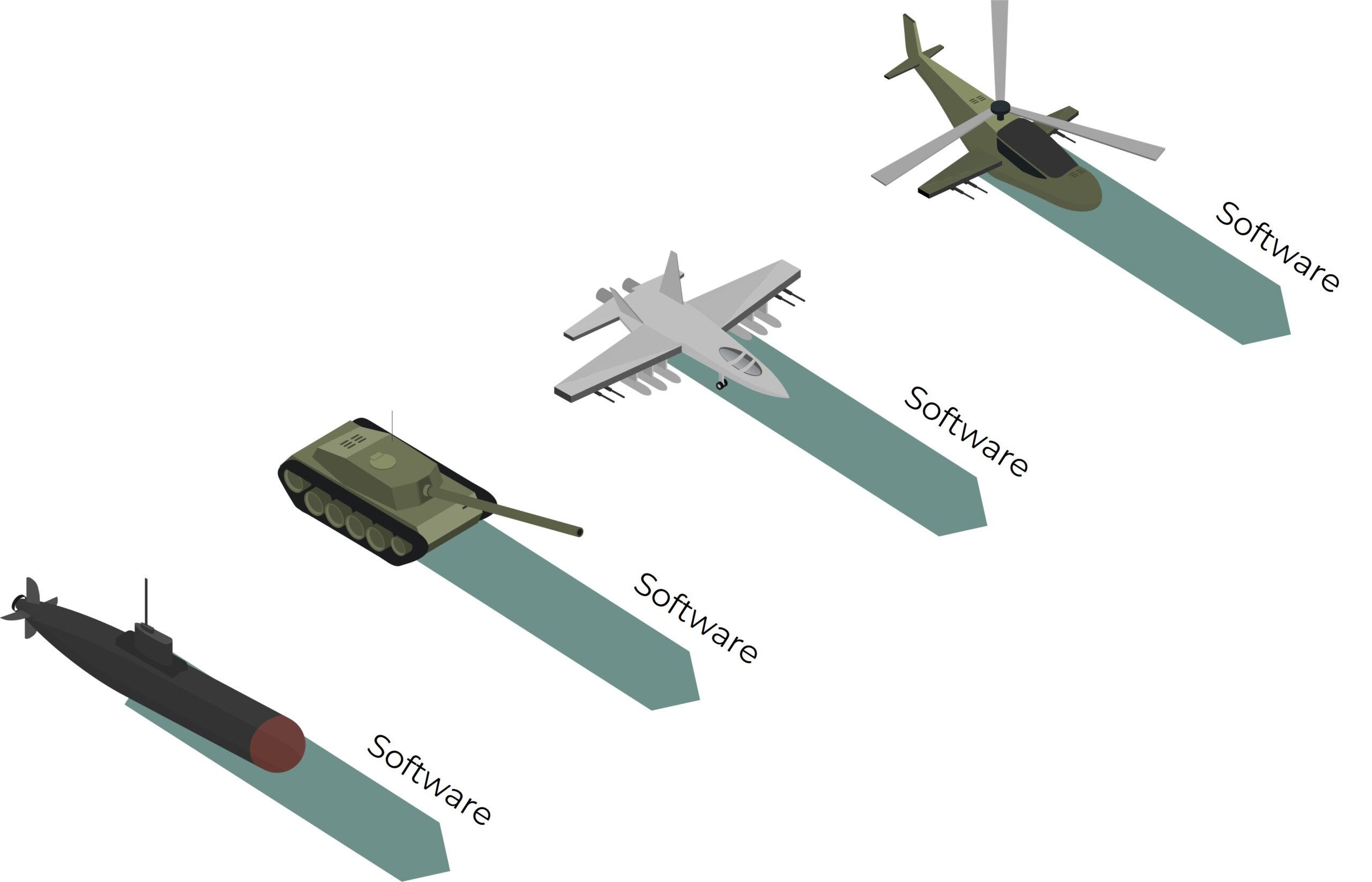
SDD is a fundamental architectural and organizational principle of modern operations, which provides for a decoupling of sensors and effectors, of software and hardware, and of data and specific applications – connected in data-centric, adaptive combat networks. In other words, previously rigidly connected components are considered separately to make them more flexible and combinable.
Software Defined Defence is built on several fundamental elements.
- This changes the relationship between software and hardware, in that technological progress in software is significantly faster, and software-defined functions increasingly determine the operational advantage.
- Second, a data-oriented approach comes to the forefront: data is viewed as a strategic resource that is integrated and evaluated across systems to achieve information dominance.
- Thirdly, SDD includes a human-centered approach to system design, for example, through API-based workflows that effectively support operating personnel.
- Fourth, advanced software and AI are considered core capabilities of weapon systems – thus they are not merely add-ons, but an integral component from the outset in development and upgrades.
Expert assessment
LautBDLISoftware becomes the „essential enabler“ of modern military operations. The ability to digitally upgrade existing systems and develop new systems with a software-centric approach is considered crucial for adapting the Bundeswehr more quickly to a changing battlefield in the era of transformation. SDD creates the conditions to respond to changing threats with software adjustments in near real-time, rather than lengthy hardware updates. Capability improvements are made situationally through modular, reusable software components – instead of rarely and expensively upgrading large monolithic systems.
Incremental development models with high agility and flexibility, as common in civilian IT, can thus be transferred to military systems. SDD is therefore seen as key to making Multi-Domain Operations (MDO) with networked, adaptable systems possible in the first place and to improving the collaboration of diverse systems. In this way, SDD is intended to massively increase the interoperability of systems with each other and thereby significantly enhance the performance of military organizations.
While classical armor systems are strongly hardware-centric in their conception and planning, SDD places software at the center – as a flexibly adaptable, reusable element that is managed throughout its entire lifecycle.Hardthöhen Courierdescribes this shift in his contribution to SDD as a paradigm shift with profound consequences for the architecture, procurement, and operation of military systems.
At its core, SDD means that capabilities will no longer be created exclusively through new platforms or hardware upgrades, but increasingly through software modules that are developed modularly and used across systems. This is associated with the ability to continue using existing systems—including legacy systems—through targeted software modernization, while simultaneously reacting faster to new threat situations.
The article emphasizes that the digital empowerment of platforms is not merely a means to extend lifecycles, but a necessary prerequisite for adequately responding to the dynamics of modern threats. In times of hybrid conflicts and increasingly data-driven operations, the ability for rapid, networked system adaptation becomes the decisive factor.
Sketch of a future architecture: Software-Defined Defense
A central aspect is the demand for agile, incremental software development. Instead of classic monolithic procurement, smaller, iterative steps are to be taken – with the goal of modularly expanding capabilities and bringing them into operation more quickly. This also entails a change in planning and product understanding: software maintenance, platform strategy, modularity, and continuous integration must be considered – and co-financed – from the outset.
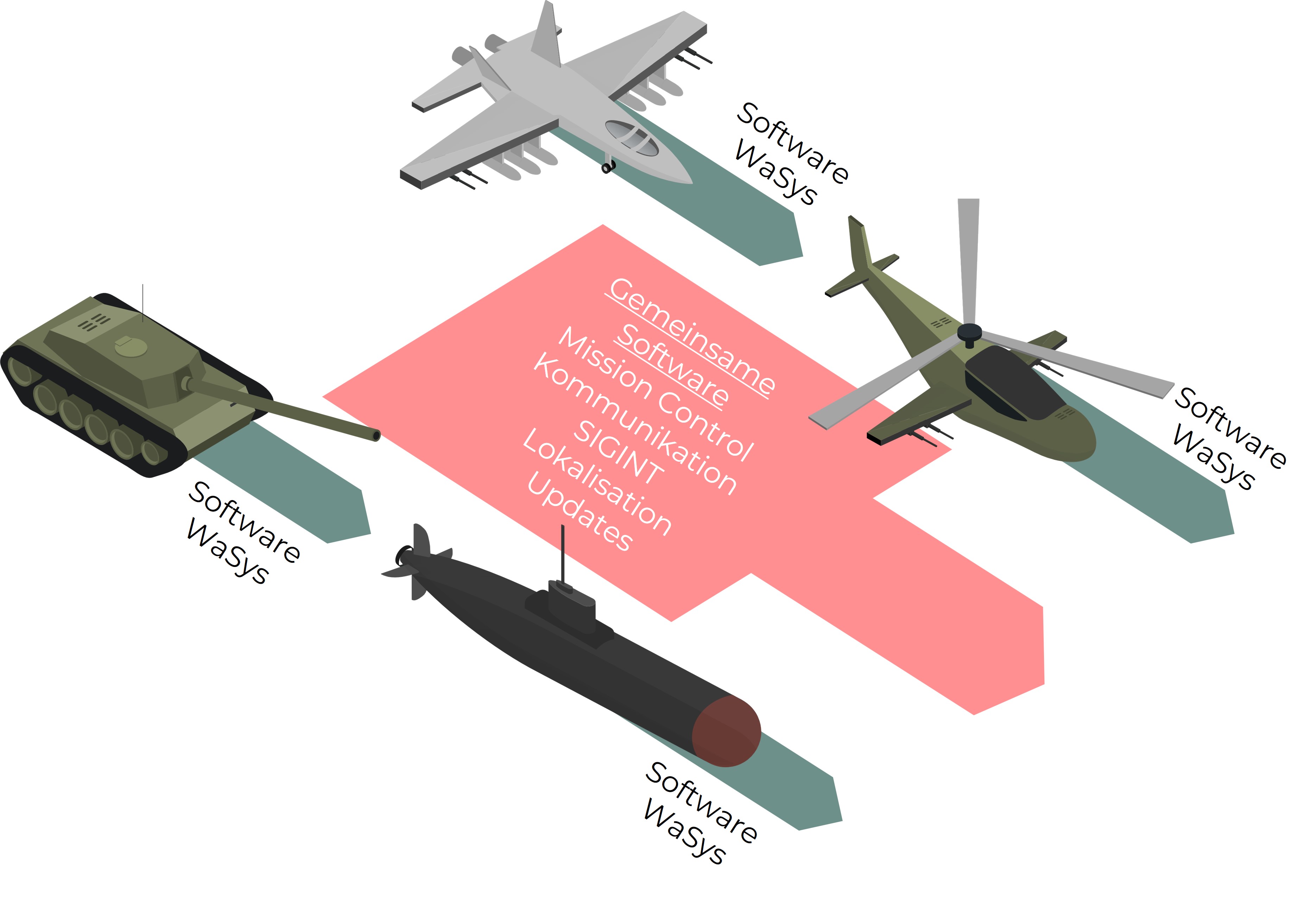
Future architecture separates between common, standardized software and application-specific weapon system software (WaSys), which is completely hardware-bound. The common software forms a central core layer, harmonized for all platforms and responsible for functions such as mission management, data fusion, communication, and updates. This creates consistent interoperability and the ability to roll out new functionalities faster.
In contrast, the WaSys software remains on the respective platforms and continues to be specifically tailored to their requirements. It handles platform-specific functions such as actuator control, sensor connection, and the respective platform logic and is not part of the common software base.
The underlying architectural principle is to break down the previously isolated development of complete software systems per platform. Instead, a common software core is established, while differentiation is targeted through platform-specific applications. This reduces redundancies, simplifies updates, and enables coordinated operations across different domains.
Technological Principles of Software-Defined Defense
An SDD approach is based on several fundamental technological principles that are intended to ensure that software changes can be implemented quickly, efficiently, and with broad impact:
Decoupling of hardware and software
The electronics platform (hardware) and the application logic (software) are logically separated to allow for largely independent use and adaptation of both. Individual software modules are intended to be reusable or interchangeable across multiple systems. This open architecture makes it possible to provide new functionalities without physically modifying the underlying device. Various weapon systems can thus also utilize common software components, accelerating development and integration.
Modular Architectures and Open Interfaces
Software-Defined Defense relies on modular software architectures with defined interfaces. Components communicate via standardized interfaces, which simplifies cross-platform networking. Open standards (e.g., the Software Communications Architecture in the radio sector) ensure that new modules or even external partner systems can be integrated without proprietary hurdles – an example is the SCA compatibility of the German Armed Forces' SDR radio system SVFuA. This increases the federatability of systems in a multinational context (keyword Federated Mission Networking), i.e., the ability to interact seamlessly with allied systems.
Integration of AI and data-driven approaches
Artificial intelligence is a key driver in Software Defined Defense. AI-based functions (such as image recognition, pattern analysis of radar/radio signals, or decision support) need to be quickly integrated and updated into systems. For this purpose, AI models must be retrained with new data, tested, certified, and deployed down to the tactical level at an accelerated pace. It should be possible to implement such models on the respective platform with low integration effort. For example, SDD can be used to consolidate the analysis of data from all sensors and sources (e.g., from C4I systems) for AI functions in order to recognize patterns that a single system would not see on its own. In short: SDD promotes a data-centric approach that leverages large amounts of data (Big Data) and AI to gain an information advantage.
Agile Development and Continuous Updates
Instead of years of hardware development cycles, Software Defined Defense enables agile, iterative software development methods in the defense sector. Rapid Development & Deployment is part of the concept: software is to be developed, tested, and regularly deployed in significantly shorter cycles. Modern methods such as DevSecOps (Development + Security + Operations) can be applied to continuously introduce new features or security patches. These incremental updates keep systems constantly up-to-date and adapted to new operational requirements, instead of having to wait for major version jumps. Important here are processes for the fast and secure distribution of updates to all platforms in use (e.g. via or maintenance teams), without jeopardizing operational readiness.
Challenges, Obsolescence, and Refactoring
A central challenge arises from the current life cycle of existing systems. Many platforms such as howitzers, warships, or tanks are currently not being replaced but are being specifically modernized and transitioned into a next phase of use. New series and entirely new system generations will generally only be available from around 2028.
This means that the existing software base cannot simply be redeveloped, but refactored and must be ported to new architectures. This adjustment affects not only large, complex systems but extends throughout the entire system landscape, down to seemingly simple components like bus converters or sensors. In addition to this Obsolescence, which must be actively managed.
Extending the lifespan of components is thus becoming a central building block of the future architecture. Existing software must be reconfigured so that it can be integrated into a common, software-defined environment without losing system-specific functions. At the same time, interfaces, communication mechanisms, and update capability must be adapted to create seamless interoperability across all platforms.
Conclusion
Software-Defined Defense marks a profound shift in the way military systems are understood. Instead of rigid, hardware-centric systems, the focus is shifting to continuously adaptable software. Modularity, AI integration, agile development, and open interfaces make it possible to dynamically expand capabilities and keep systems operational over the long term. SDD is thus not only a technological innovation but also a strategic necessity for armed forces in the 21st century.